
Branch No. 5
Branch 5 Captain: Volunteer needed.
...............................................................................................................................................
LAST NUMBER USED: 56
................................................................................................................................................
1 BEN or EBEN (1) LATTA
Nearly all the following was given me (Robert Latta) by Samuel Rankin Latta of
Dyersburg, Tenn. It was taken from an old family Bible (1903) in his possession
and has been a family possession for several generations. It was presented in
London, England in 1602 of the Geneva translation and known as the "Breeches"
Bible. John Gilchrist Latta says: "At the top of the page the name of Thomas
Sandie is written. He was a relative of the family and from whom the book was
probably handed down. The paper is the book is decaying and one of the dates are
not perfect. I cannot be sure of my great grandfather's name. The initial letter
is "E, but I cannot determine the remainder of the name." It may be Ephraim or
it may be Eben as he named one of his sons Eben.
Children:
2 EBEN (2) b. February 19, 1744.
3 MARY (2) b. September 16, 1747.
4 JANE (2) b. February 20, 1749.
5 JOHN (2)b. Oct. 22, 1754 in Westmoreland Co., PA.
6 MARGARET (2) b. December 25, 1751.
5 JOHN (2) LATTA
____ (1). Born in Ireland October 22, 1754; d. in Westmoreland Co., Pa. prior to November 23, 1802 as letters of administration were then granted to his widow, Mary Latta, James Parr and John Woods. Surety was John Rankin and Peter Horbach.
John Latta was accidentally killed while erecting a mill on Lyalhanna Creek, Westmoreland Co., Pa. Married Mary Rankin. She was born about 1753 and died January 25, 1826, aged 73 years at the home of her son, John (2d) in New Alexandria, Pa.
John Latta also lived in Salem Tp. Pa. Millwright. His descendants do not know anything of the history of him or his wife or of his other children except John (2d) and that one of the girls married a man named Rankin perhaps in Indiana or in Westmoreland Co., Pa. She left one daughter, who died at an early age at New Alexandria, Pa. John came to America sometime between March 21, 1789, the birth of his son, John (1st) 1789 in Ireland and the birth of his son Ephraim (2d) in America in 1792. He first settled in Lancaster Co., Pa. and afterwards in Westmoreland Co., Pa. where he died. He assigned land warrant dated April 3, 1769(?) to land in Indiana Co. then Westmoreland Co., Pa. - Gov. John Latta, branch No. 10.
Children:
7 GINNEY MARY (3) b. in Ireland November 15, 1783.
8 PEGGY (3) b. in Ireland August 15, 1795. Came to America. John Hart,
guardian.
9 EPHRAIM (1st) (3) b. in Ireland May 21, 1787. Died young.
10 JOHN (3) (1st) b. in Ireland March 21, 1789. Died young.
11 EPHRAIM (3) 2d. b. in America July 3, 1792.
12 POLLY (3) b. in America November 12, 1793.
13 JOHN (3) 2d., b. April 15, 1796 in Lancaster Co., PA.
14 JENNY (3) b. in Lancaster Co., Pa. May 27, 1796. (Note dates of John
and Jenny's birth being same year. One of them is wrong)
Guardians of John and Jenny were Col. Alexander Craig, John Hart and Nicholas
Day appointed at the March term of the Orphans' Court in Westmoreland Co, Pa.
Center Township - Indiana Co., PA Taxable Inhabitants 1807
Mary Latta - no occ given
John Rankin - farmer
13 JOHN (3) 2nd LATTA
John (2) ____ (1). Born in Lancaster Co, Pa. April 15, 1796; d. at Dyersburg, Tennessee on December 2, 1872. His obituary read: “Mr. Jon Latta, the father of Capt. S. R. Latta, of Dyersburg, died at the residence of his son in that town, December 2d, in the 77th year of his age.” He married Lucinda E. Gilchrist at Harrisburg, Pa. She was born in Dauphin Co, Pa. March 31, 1793, daughter of John and Ellen Berryhill Gilchrist. Her father was a lieutenant in the Revolutionary War. Lucinda’s mother resided with John 2nd and Lucinda and received a government pension up to her death in 187_.
In 1837 John 2d went to Blairsville, Indiana Co., Pa. where his children grew up. He learned the saddle and harness makers trade at Greensburg, Pa. and worked at his trade at New Alexandria, Pa. The 1850 census for Indiana County, PA listed John Latta, age 53, saddler; wife Lucinda, age 53, son John, age 25, teacher, son William, age 23, no occupation; son Samuel, age 22, student, son James, age 19, saddler, and an Eliza Hawkins, age 18.
In 1855 the rest of the family removed from Blairsville, Pa. to Dyersburg, Tenn. Gov. John Latta, branch No. 10, said that John 2d was related to him and to Ephraim Latta, branch No. 10. These two families resided at our place and visited each other. In the 1860 census, John 2d was living with his son, Samuel Rankin Latta and is listed as a “saddler.”
Children:
15 JOHN GILCHRIST (4) b. May 1, 1824; d. May 12, 1901.
16 WILLIAM BERRYHILL “Berry” (4) b. February 1, 1826; d. Dec. 3, 1877.
Buried at the City Cemetery, Dyersburg, TN. Saddle and harness maker. In the
1870 census for Dyersburg, TN, he is listed as “disabled” and is living with his
parents, John Latty, age 73, disabled, and Lucy Latty, age 77, disabled. The
lived next door to Samuel Ranklin Latta.
16 SAMUEL RANKIN (4)* b. Dec. 2, 1827; d. July, 1911.
18 JAMES MITCHELL (4) b. Oct. 16, 1829; d. 1857.
19 FRANCIS HENRY (4) b. October 28, 1831; died in infancy.
20 FRANCIS HENRY (4) 2d, b. December 5, 1833; died in infancy.
21 JAMES M. (4) .
15 JOHN
GILCHRIST (4) LATTA
John (3) John (2) ____ (1). Born in New Alexandria, Pa. May 1, 1824; d. at Atlanta, Ga. May 31, 1901. He is buried at the City Cemetery, Dyersburg, TN. His tombstone reads "John Cilchrist Latta.: He married twice: (1) Mary R. Silsby on August 14, 1860 at Newton Corner, Mass. She died there October 18, 1870. She was born at Acworth, N.H. December 4, 1830. (2) Ellen F. Dascomb, daughter of Philip F. and Elizabeth (Peters) Dascomb, in Newton, Massachusetts March 26, 1872 by the Rev. J. W. Wellman. John is listed as postmaster. Ellen was born at Antrim, N.H. on March 8, 1838 and died in 1922. She is buried at the Parkholm Cemetery, LaGrange Park, Cook Co., IL. John Gilchrist, who was listed as a teacher in the 1850 Census in Indiana Co., PA, in 1862 moved from Dyersburg, Tenn. to Newton Corner, Mass. where he was postmaster for a number of years. He was a member of the Waban Lodge No. 156, IOOF of Ward One, in Newton, Mass. He evidently returned to Dyersburg before his death.
Children by first wife:
22 LILLIAN (5)
b. July 28, 1861; m. Henry H. Hayes of Chicago, Ills. March 9,
1892. In 1904 lived at Hinsdale, Ills.; in 1912 at Worcestor, Mass. She said
that in 1904 Spiaso Latta, an Italian, was murdered in Chicago. This shows the
name in Italy. Children: Pauline b. March 24, 1893. Marion b. October 6, 1894.
Henry H. b. February 24, 1897. Kathryn b. July 10, 1898. John Otis b. September
30, 1901.
23 FLORENCE (5)
b. April 30, 1864; m. George A. Combs October 1891. Children:
Zella Silsby b. August 28, 1893. Leota Florence b. December 14, 1894. Joseph
Charles b. November 3, 1895. Abbie Lucile b. June 7, 1901. Dorothy Dale b. April
24, 1903. In 1912 living at Riverside, Calif.
24 MARY
CORNELIA (5) b. April 7, 1866; m. Clarence A. Brodeur June 24, 1887
of Westfield, Mass. Children: Arthur Gilchrist b. September 18, 1888. Mary
Silsby b. March 19, 1892. Marion Marsh b. twin with Mary. Harold Hills b. June
25, 1894. Paul Evans b. May 3, 1901. Clarence Gordon b. October 18, 1905.
25 JENNIE LOUISE (5) b. April 6, 1869; d. February 2, 1876 of diptheria.
Children by Second Wife:
26 SAMUEL WELLMAN (5) b. March 21, 1876. (Evidently his parents named him after Rev. J. W. Wellman, who married them)
57 WILLIAM WAITE LATTA (5) b. July 14, 1873; died Feb. 2, 1876 of diptheria. The Boston Globe on Monday, Feb. 7, 1876, stated “Postmaster J. G. Latta has lost two children by diptheria.” William and his sister, Jennie Louise, died the same day.
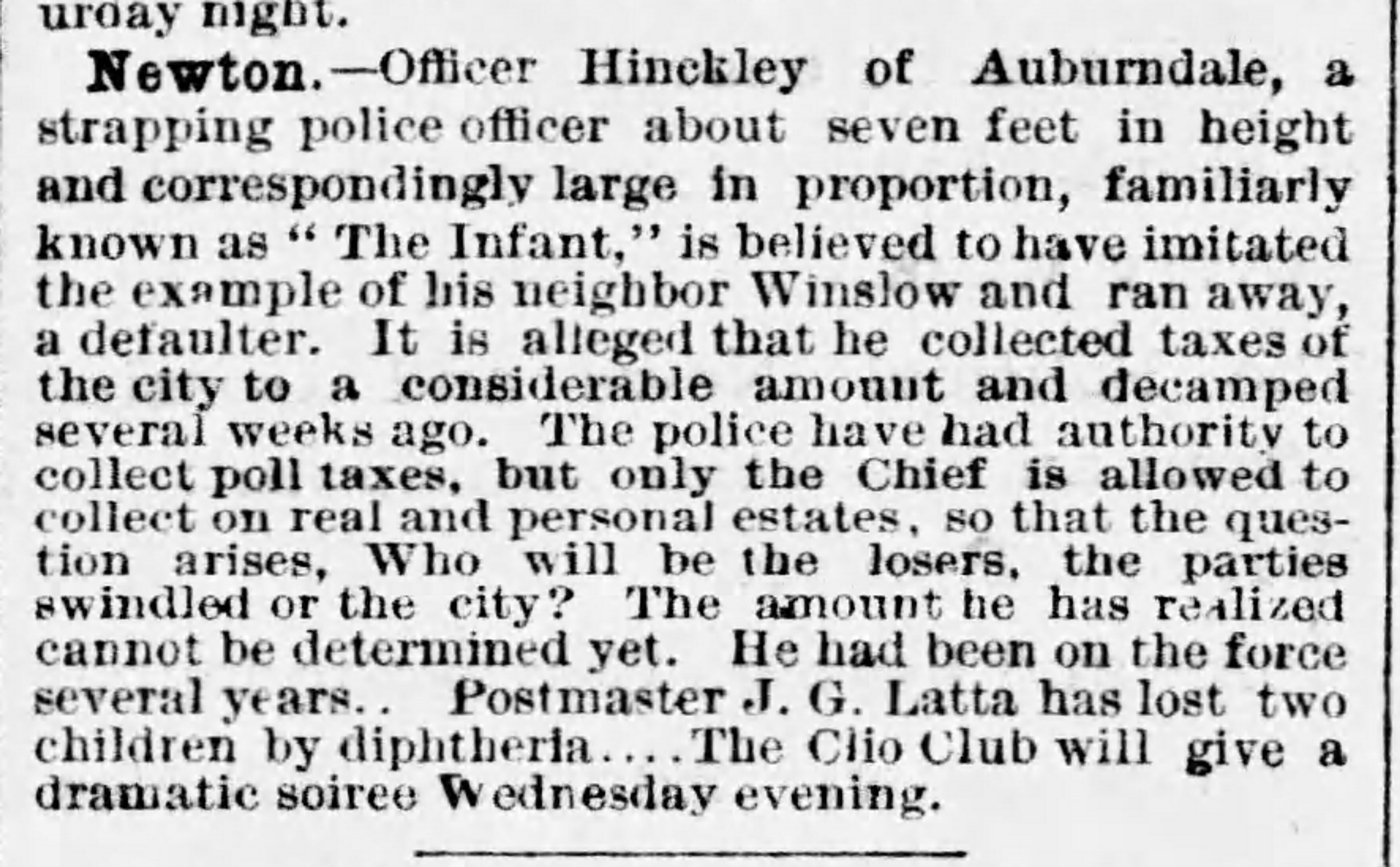
The Boston Globe, Mon. Feb. 7, 1876
17 SAMUEL RANKIN (4) LATTA
John (3) John (2) E____ (1). Born in New Alexandria, Pa. December 2, 1827; d. at Dyersburg, Tenn. July 11, 1911; m. Mary Granger Guthrie on December 9, 1852. She was born in East Tenn. of Scotch parents on Aug. 8, 1833. She died on Sept. 8, 1920. They are buried at the City Cemetery, Dyersburg, TN. He took a three year's course at Blairsville, Pa. Academy and taught for 18 years. Graduated at Jefferson College, Cannonsburg, Pa. in 1850. Taught in Dyersburg, Tenn. for three years. Studied law. Admitted to the Bar in 1854 and practiced until his death. His son Samuel G. was his partner. Was a Captain in the Confederate Army during the first year of the war, "TN Capt. 13 TN Inf CW" is on his tombstone. He was a Worshipful Master of the Hess Masonic Lodge. His home located at 917 Troy Avenue, Dyersburg, TN is on the National Register of Historical Places.
Children:
27 JOHN
GUTHRIE (5) b. June 21, 1857, educated at Newton, Massachusetts, and at
Poughkeepsie, NY, and by private teachers at home, clerked in the Merchants
National Bank, Little Rock, Arkansas.
28 KATE (5) b. October 17, 1859; educated at home by private teachers,
married Prof. Thomas C. Gordon, a native of Louisiana, and had three children,
Mary, Winfield Osceola, and Sadie. Lived at Dyersburg, Tenn.
29 SARAH KNOTT (5) b. February 12, 1862, educated by private teachers at
ome, attended Mary Sharpe College, Winchester, Tennessee for one year. Married
Rev. W. M. Anderson, Presbyterian. Lived at Rock Hill, S.C. One child.
30 MARY ELEANOR “Nellie” (5) born March 9, 1864, educated by private
teachers at home.
31 FRANK WALLACE (5) born July 4, 1866, educated at Southwestern
University, Clarksville, Tennessee, d. in 1936.
33 SAMUEL GRAINGER (5) born August 5, 1871; d. 1934.
Tennessee's Forgotten Warriors: Frank Cheatham and His Confederate Division, by Christopher Losson
p. 35 "James Rosser of the Twelfth Tennessee wrote that "the bullets whistled above our heads and our feet...Samuel Latta of the Thirteenth Tennessee wrote that the Yankees were posted in the woods and that the Southerners were subjected to a "perfect hail of bullets from an enemy that we could scarcely see." ...Latta was struck on the hop by a minie ball. He checked the wound, "expecting to find [his hands] covered in blood" but was "agreeably surprised to discover that his watch fob flap had deflected the bullet. Latta was bruised, but not bloodied....Samuel Latta of the Thirteenth Tennessee reported: "we stood behind the trees and shot them down. I saw them fall in my direction." Latta, an officer, rushed up to a fleeing Federal and "seized him by the neck," an action which convinced the Yankee to "surrender without a struggle." Latta wrote later, "The poor fellow was worried [and] frightened to death," a fairly sensible reaction considering the manner in which he was captured. If Latta and his comrades had been nervous earlier, this sentiment appears to have dissipated as they pursued Grant's troops.
The State Gazette, Dyersburg, TN, Thursday, June 13, 1907, stated “ Capt. LATTA was thrown from his buggy Tuesday morning in front of R. F. C. MOSS' residence, and while he suffered no serious injury, he was badly shaken up.”
Obituary – “Capt. S. R. Latta, one of the oldest citizens of Dyersburg, Tenn., died there on July 12, 1911, after nearly a year’s illness. He was eighty-six years of age and had lived there sixty-one years. He was a native of Pennsylvania. When the war broke out, he organized a company at Dyersburg and served as its captain through the war. After the war he began the practice of law and continued in the profession until his retirement on account of advanced age. He was a prominent member of the Confederate Veteran Camp at Dyersburg, and it was his custom to give his old comrades a picnic on his lawn once a year, and the boys in gray always had a good time on those occasions. They loved their old captain and will ever revere his memory. His wife survives him, also three sons and three daughters. Mrs. W. M. Anderson, wife of Rev. Dr. Anderson, formerly pastor of the First Presbyterian Church of Nashville, is his eldest daughter. Captain Latta was a Mason and a charter member of the local lodge, which is one of the oldest in the State.
Capt. Samuel Rankin’s biography is contained in a book titled “Sketches of Prominent Tennesseans” and states that his grandfather, John Latta, was born in Ireland, married a Miss Rankin there, and settled in eastern Pennsylvania. Additional information in the biography states that Samuel Rankin Latta’s father, John Latta, died in Dyersburg, TN, at the age of seventy-six, leaving three surviving children, John G. Latta, William B. Latta and Samuel R. Latta. John G. Latta has for fifteen years been postmaster at Newton, Massachusetts, William B. Latta died at Dyersburg, unmarried. Another son, James M. Latta, died in 1857. He married in Pennsylvania, and left two children, Lucy, now wife of John G. Seat, of Dyersburg, and Samuel J, now in mercantile life at Memphis. Capt. Latta’s mother, who died in Dyersburg in 1870, at the age of eight-one, was born near Harrisburg, Pennsylvania, the daughter of John Gilchrist, a planter and slaveholder in Dauphin County, Pennsylvania. He was a lieutenant in the Revolutionary War. He married a Miss Berryhill, of Dauphin County. The biography stated that Samuel Rank Latta attended common schools and academy in Indiana County, PA, until the age of seventeen, when he left home to attend school. In boyhood he did but little work, except at the age of fourteen, when he worked one year in his father’s saddler’s shop. When he started to the academy, which he attended three years, his ambition was to become a lawyer, but his hopes were deferred for a number of years. At the age of seventeen he taught school in Westmoreland County, PA, He attended Washington College and graduated from Jefferson College in 1850. He made the money himself on which he was educated. Once he graduated, he came south looking for a position as a school teacher, as the pay as better south than in the north. He came to Dyersburg by accident. He had taken passage on an Ohio river boat for Memphis, intending to go to Mississippi, when a fellow passenger told him of a vacant situation at Dyersburg. He came to that town on foot from Hickman, TN carrying a big carpet bag. Capt. Latta often laughed and called himself the original carpet bagger. Soon after acquiring the teaching position, he married and settled, and upon his death still occupied the house he first lived in, one-half mile from town. Samuel began studying law in Dyersburg at the age of 25, under Col. T. E. Richardson, who he later became partner with. Samuel took time off from his law practice during the Civil War when he became Captain of “The Dyer Grays”. He fought at the battles of Belmont and Shiloh, and left the army after the latter engagement on account of domestic afflictions at home. Capt. Latta was raised by Presbyterian parents, joined the church in 1858, and was a ruling elder for 25 years. He served as Sunday school superintendent for 15 years. Samuel was a “sky-blue” Democrat, was made a Master Mason in Hess Lodge No. 93 in Dyersburg, and took the Chapter degrees and filled all the offices in both Lodge and Chapter. He joined the Odd Fellows in 1851, and passed all the chairs of both Lodge and Encampment. He became a Knight of Honor in 1881. By his marriage to Miss Guthrie, Capt. Latta had six children, John G. Latta, Kate Latta Gordon, Sarah K. Latta, Mary Eleanor “Nellie”, Frank Wallace Latta, and Samuel Grainger Latta.
The Samuel Rankin Latta Papers, 1848-1862, are kept at the Tennessee State Library and Archives, where microfilmed copies of several letters can be found and read online. The entire collection consists of 4 volumes and 32 items. The letters in the collection are personal correspondence between family members during the Civil War. One such letter from his son, J. G. Latta (John Guthrie) dated June 7, 1861 states:
“Dear Father
Your letter of the 28th May was received last evening. I rejoice to hear that the health of yourself and mother improves. God grant that your health and lives may be spared until we can meet again. When that will occur is known only to Him, “who knoweth the end from the beginning”. Tomorrow is the day upon which Tennesseans are called upon to determine their status in the present struggle. Should they by a majority pronounce in favor of secession, the only channel of communication now left will be closed, and we cannot communicate with each other. So far as our safety and comfort are concerned, you need have no anxiety; we are in the midst of friends, and have nothing to fear. I know also that you are in the midst of friends, but, none can tell how soon your section may become the scene of strife and bloodshed, and although you may not have to look upon the actual strife, yet you must to some extent feel its affects. We are assured that no evil shall come near the dwelling of the righteous, yet they may have to bear many of the ills of life and death itself may come suddenly and unexpectedly upon them, but the “end is everlasting life.” In that we have our great consolation and reward for whatever we may be called upon to suffer.
This country now looks beautifully. The season is favorable, and everything grows luxuriously. The pleasures of living in this climate in the summer is very much marred by the east winds from the ocean; they are cold and disagreeable, especially when accompanied by rain, as at present. We are well, and get on comfortably. Mary sends love to you all. My sweet mother, Mary, Sam and Berry, and remember me to Mary W. and Maj. And all inquiring friends. Tell Dr. Richardson that the niggas in here is about 12 feet under me, except among abolitionists in the building.
That God may protect and bless you all, is the daily prayers of
Your affectionate son
J. G. Latta
P. S. Give the enclosed skip to Sam’l. If he has left home, send it to him.
18 JAMES MITCHELL (4) LATTA
John (3) John (2) E____ (1). Born
October 16, 1829, probably at New Alexandria, Pa. as his father did not leave
there until 1837. Died at Dyersburg, Tenn. in 1857. Married ____. He was a
saddle and harness maker.
Children:
34 SAMUEL JAMES (5) in 1890
lived at Memphis, Tenn., mercantile.
35 LUCY (5) m. John G. Seat. Lived at Trenton,
Tenn. in 1890. Children: Glenn Latta Seat; b. 1872; d. 1839; Glenn Latta Seat
married Mary Harwood who was born 1874 and died 1956. They had one child named
Harwood Latta Seat, born 1899; died. 1927. Glenn Latta Seat, Mary Harwood Seat,
and Harwood Latta Seat are all are buried at the City Cemetery, Dyersburg, TN
26 SAMUEL WELLMAN (5) LATTA
John G. (4) John (3) John (2)
E____ (1). Born March 21, 1876; d. 1947; buried in Parkholm Cemetery, LaGrange
Park, Cook Co., Illinois; m. Mary William of Putnam, Ills. August 29,
1907. In 1912 lived at LaGrange, Ills.
LATTA-WILLIAMS. At the home of the bride's parents, Mr. and Mrs. J. Howard Williams, near Putnam, Illinois, on Thursday, August 29, 1907, Samuel Wellman Latta, of La Grange, Ill., and Miss Mary Williams, the Rev. L. G. Landenberger officiating.
Children:
27 JOHN GUTHRIE "Jack" (5) LATTA
Samuel R. (4) John (3) John
(2) E____ (1). Born: June 21, 1857 Dyersburg, Tenn. Died: Dec. 27, 1925
Dyersburg, Tenn. Married: Leanora Lee Poland, Dec.6, 1882 at Marshall, Texas.
She was Born: Aug 26,1859 in Texas. She died: March 22, 1951. She was the
daughter of John Stratton Poland & Carrie Gray. In 1904 worked in a bank at
Dyersburg, Tenn. 1920 Census - Dyersburg, Dyer Co., TN -
Latta, John, age 62, born in TN.
Children:
39 NELLE (6)
Born: Nov. 13, 1883 Texas. Died: Oct. 28, 1961 Texas. Married: Hampton Oscar
Marley in 1907.
40 LESLIE VIRGINIA (6) Born: Apr. 26, 1886. Died: Jan.
30, 1967 Texas; m. Harry B. Watkins Aug. 15, 1907.
41 FLOY (6) Born:
May 6, 1892 Dyersburg, Dyer Co., Tenn; m. Robert Jones, Sr. Dec. 19, 1911
Dyersburg, Dyer Co., Tenn. Two children: *1) Robert Jones Beasley Jr, Born: Jan.
26, 1913 In: Texas. & Dorothy Latta Beasley, Born: May 19, 1914. Texas.
STATE GAZETTE
DYERSBURG, TENNESSEE
42ND YEAR NO 23
JUNE 6TH, 1907
MARLEY & LATTA--The Cumberland Presbyterian church was the scene Tuesday evening of the beautiful Presbyterian ring ceremony said by Rev. Geo. P. SCOTT, united Miss Nelle LATTA, second daughter of Mr. & Mrs. John G. LATTA, of this city, and Hampton Oscar MARLEY, of Memphis. Her grandfather, Capt. S. R. LATTA, being one of the pioneers of this part of the State. The groom is also a native Tennessean and occupies a position of responsibility with Galloway Coal Company, Memphis. The audience was entertained with "The Budion Love Song.” and "Love Me, “ and "The World Is Mine.” sung by Mr. Granger LATTA and Miss Louise BRACKIN. Mrs. Robert McKNIGHT played Mendelsshon's wedding march as processional and Lohengrin's as recessional. The bridal party was preceded down the aisles by the little flower girls, Mary Granger GRIGSBY, Mary LATTA, Kate LATTA, and Belle LATTA, all dressed in dainty white dresses. They were followed by the attendants, Miss Floy LATTA, sister of the bride, Miss Kate GORDON, cousin of the bride, Miss Cano FERGUSON, Miss Janie COOVER, Miss Nell THOMAS, of this place and Miss Bertha WOOLLEN, of Memphis, gowned in white mulle over silk, with elaborate lace trimmings. The best man was F. N. MARLEY, of Memphis, brother of the groom, A. H. MURRAY, J. R. MURRAY, A. W. LAMBERT, J. A. WEBER, all of Memphis and H. B. WATKINS, Stoy DAWSON, W. O. GORDON, of Dyersburg, groomsmen. The matron og honor, Mrs. Albert Russell ERSKINE, of Memphis, cousin of the bride, preceded the maid of honor, Miss Leslie LATTA, the bride's sister. The bride entered on the arm of her father, John G. LATTA, who placed her in the keeping of the bridegroom at the Chancel. Her dark beauty was brought out to perfection by a handsome white duchesse satin gown with lace trimmings. The full length veil was caught with a wreath of orange blossoms. Immediately after the ceremony, an elaborate ceremony was tendered about 200 specially invited guests at the home of the bride's father. A perfect wealth of elegant gifts many from a distance, were received, among the handsomest being a chest of silver from S. Granger LATTA, an uncle of the bride. Mr. & Mrs. MARLEY left on the 9 o'clock train for a two weeks trip to Ashville and vicinity.
STATE GAZETTE
DYERSBURG, TENNESSEE
42ND YEAR NO 31
AUGUST 1, 1907
THURSDAY, AUGUST 1,
1907--Cards are out announcing the engagement and approaching
marriage of Miss Leslie Virginia LATTA to Mr. Harry Beaumont WATKINS.
The
ceremony will be said at the residence of the bride's parents,
Mr. & Mrs.
John G. LATTA Thursday evening, August 19th at 9 o'clock.
(Picture 1900)
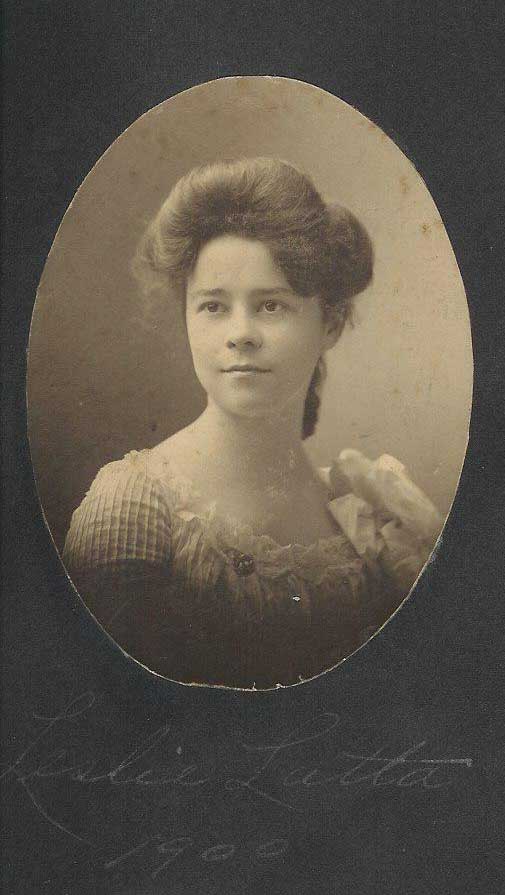
THE STATES GAZETTE
DYERSBURG, TENNESSEE
42ND YEAR NO. 34
AUGUST 22,
1907
LATTA & WATKINS--The wedding of Miss Leslie LATTA and Mr. Harry WATKINS, of this place, was solemnized at 6 p. m. Thursday at the home of the bride's parents, Mr. & Mrs. J. G. LATTA. Only the members of the two families and neighbors were present, the entire plans of the wedding changed because of the illness of the groom's father, Mr. B. B. WATKINS.
31 FRANKLIN "Frank" WALLACE (5) LATTA
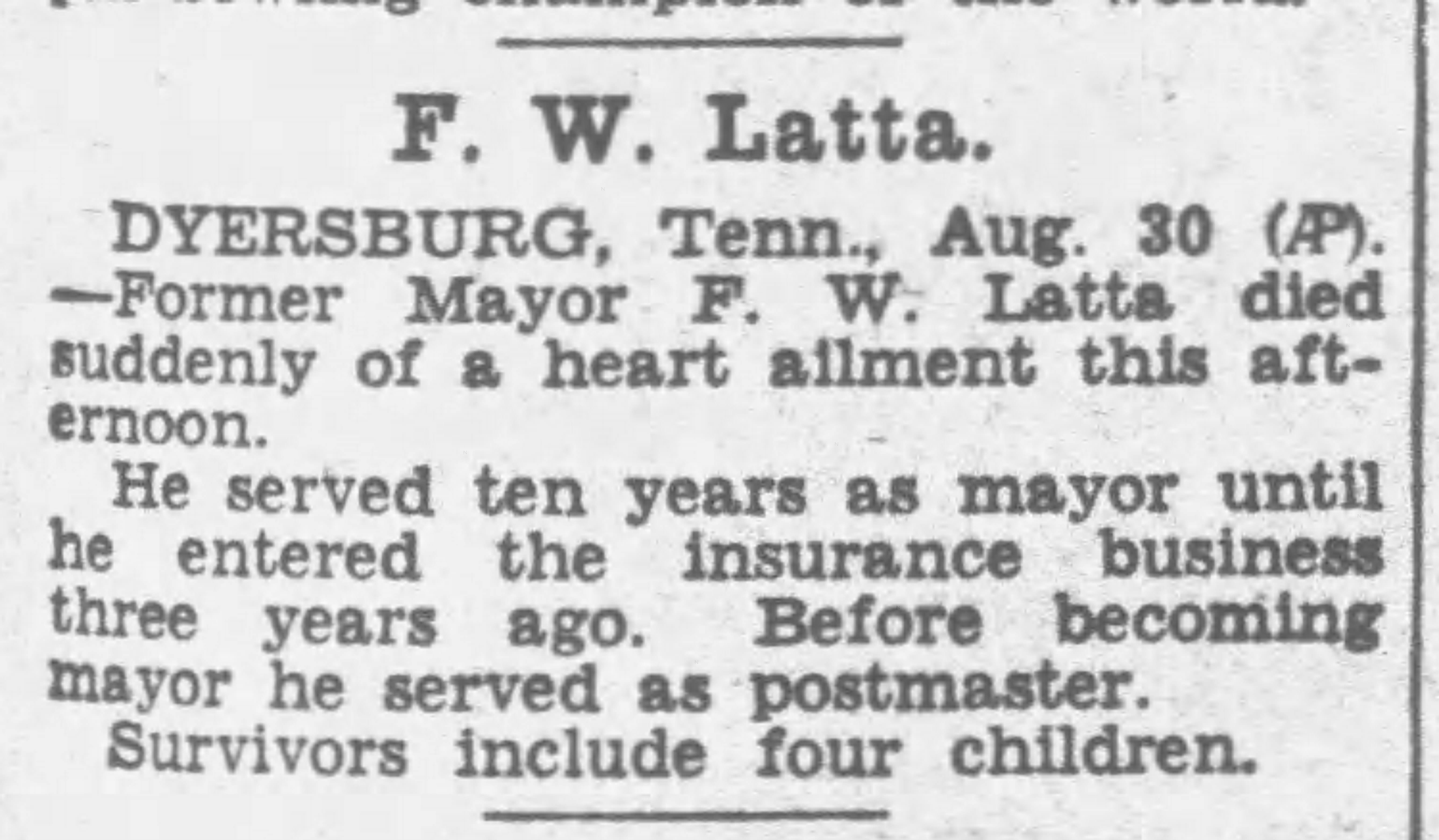 Chattanooga Daily Times, Monday, August 31, 1936
Children:
Chattanooga Daily Times, Monday, August 31, 1936
Children:
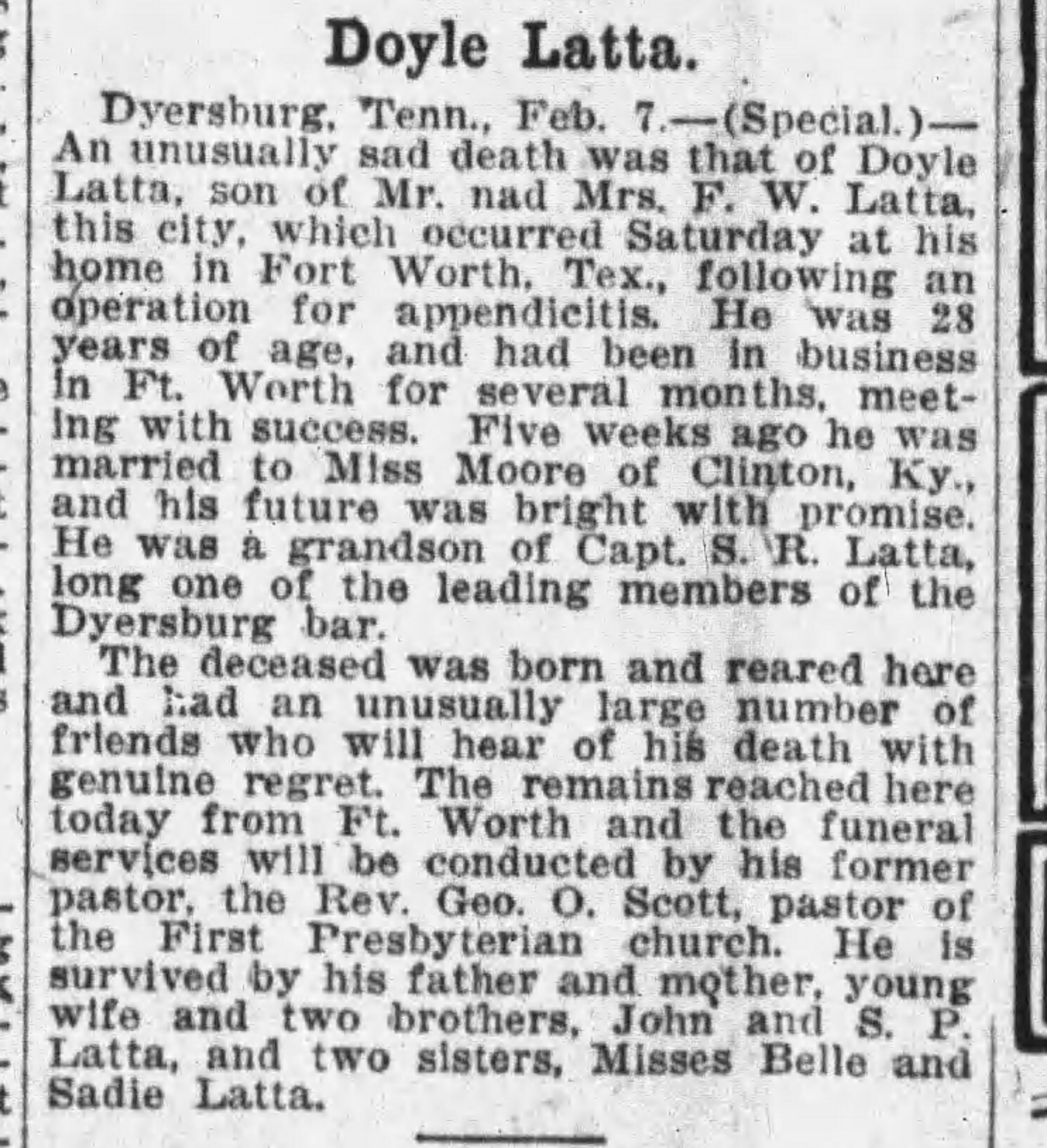
Nashville Banner, Nashville, TN - Monday, Feb. 7, 1921
33 SAMUEL GRANGER (5) LATTA
Samuel R. (4) John (3) John (2)
E____ (1). Born 1871; d. January 1, 1934 of a heart attack in Dyersburg, TN; m. Eveleen Pardoe. She was born in 1874 and died
in 1963. Law partner with his father. In 1932 lived at 1356 Troy Ave.,
Dyersburg, Tenn. He and his wife, Eveleen are buried in the Mausoleum of the
Fairview Cemetery, Dyersburg, Dyer Co., Tennessee. His grave marker reads "S.
Granger Latta."
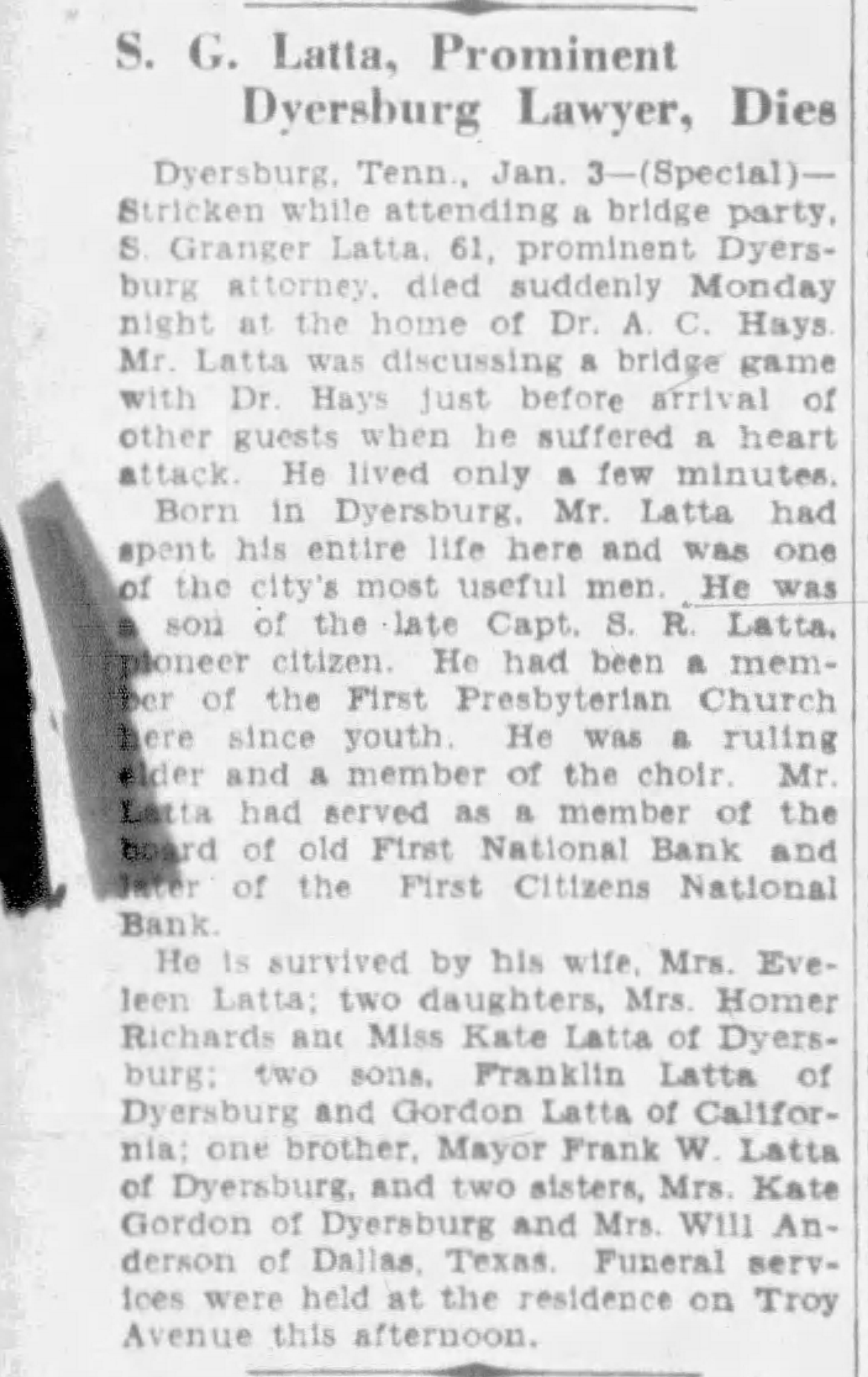
Nashville Banner, Wednesday, January 3, 1934
Children:
42 FRANKLIN W. (6) b. Aug. 4, 1897;
d. Feb. 28, 1958; TN 2nd LT SC WWI; buried at the Fairview Cemetery, Dyersburg,
TN.
43 GORDON G. (6) b. Sept 30, 1903; d. Apr. 8, 1977. Buried at the
Fairview Cemetery, Dyersburg, Dyer Co., TN.
44 CATHERINE (6).
45
MARY E. (6) b. May 29, 1899; d. 1984; m. Homer Richards.
46 EVELEEN (6) b. 1905 at Dyersburg,
Tenn.; d. January 26, 1933; m. Mr. Fowlkes.
Lived in Tipton, Tenn. She was
buried in the Mausoleum of the Fairview Cemetery, Dyersburg, Dyer Co., Tenn.
THE STATE GAZETTE
DYERSBURG,TENNESSEE
VOLUME XXVI NO.14
SATURDAY APRIL 4,1891
NON-RESIDENT NOTICE IN
CHANCERY COURT AT DYERSBURG,TENN.--Mary Ella SMITH vs
Lucien W.SMITH. #1331
R.D. (must appear by first Monday in May. This 20th day
of March 1891. J W
LAUDERDALE; Clerk & Master. S R LATTA, Sol.for Complainent.
PERSONAL
MENTION--Granger LATTA is at home sick. F A BOLING has gone East
for goods.
THE DYER COUNTY PROGRESS VOLUME 5 NUMBER 35
DYERSBURG,TENNESSEE THURSDAY,JUNE
1,1876
A SHORT SKETCH OF THE CORONATION: Editors Progress---Last Friday eve, I had the pleasure of attending the crowning of the May Queen at the Court House, (description of stage lengthy, will exclude). Music was rendered by these splendid amateur performers; Miss Fannie STEVENS, Miss Anna WEBB, Miss Ella BRACKIN, and Mr. J. M. BRACKIN.At last the Herald announced the approach of the Queen-elect, Miss Sadie LATTA, who was conducted to center stage by her attendants and crowned Queen O'the May by her first and second Maids of Honor; Misses Belle DIXON and Willie WATKINS. The Queen's pages were Misses Nellie WEBB and Mary STEVENS. Miss Dixie DAWSON represented Spring to perfection; Miss Mary BURKE was Summer; Autumn was Miss Manie WEBB. Winter was Miss Mary PHILLIPS. Little Minnie JONES acted the part of Gypsy Queen; the Woodland Favs were Katie SAMPSON and Katie McAllister. Misses Tommie DAWSON and Nora WALKER assumed the part of Night and Day. Lizzie HIBBETT and Pearl DOYLE were Water Sprites. Undine was Miss Ella FOARD. The Indian Princess was Julia SOLOMOM. The representative of Wealth was Miss Ella NEAL. Faith, Hope and Charity were Misses Georgia MILLER, Lou DOYLE and Lon PATE. Herald was Miss Ella MOSS. We cannot comment to highly upon the beautiful manner in which they acquitted themselves and must say the whole affair was the work of skilled hands. Suffice to say that the like was never before seen in a place the size of Dyersburg.N_______May 20th,1876.
STATE GAZETTE
DYERSBURG, TN
42ND YEAR NO. 11
MARCH 14, 1907
UNION REVIVAL BEGINS--Dr. George H. CRUTCHER opens the initial service with a talk on prayer. The choir, composed of some forty voices rendered a pleasing musical program. S. Granger LATTA, the leader, and the members of the choir deserve much praise. Mrs. R. L. McKNIGHT, as accompanist, is assisting Mr. LATTA.
THURSDAY MARCH 14, 1907--Frank J. NUNN, of Brownsville, is in the city. Mrs. Henry A. KLYCE will entertain the Saturday Afternoon Club, March 23rd. Misses Virginia & Mackie SHUMATE, of Newbern, came down Monday evening to attend the Forked Deer Club dance. Miss Annie ARNOLD leaves for Paducah in a few days, the guest of Miss Clyde BARHAM. Mrs. John LATTA and Miss Leslie have returned from a visit to Memphis. Ernest GWARTNEY spent several days this week in St. Louis. Will Dock FOWKLES is quite ill with pneumonia. Mrs. H. J. RICHARDS entertained with six hand euchre Saturday evening. Miss Kate GORDON won first prize and Miss Nell LATTA won the consolation. ...John G. LATTA and S. Granger LATTA were last Sunday elected superintendent and assistant superintendent of the Presbyterian Sunday School.
37 JOHN DONALD (6) LATTA
Samuel Wellman (5) John G. (4) John (3) John (2)
E____ (1). b. January 27, 1910. Died
Oct.
6, 1988 in Hennepin Co, MN. Married to Flossie Witt Latta (1913-2015).
JOHN DONALD LATTA, THE STORY OF HIS FAMILY AND HIS LIFE - by his wife, FLOSSIE WITT LATTA and their children. (The Latta Genealogy Newsletter - Summer 2022)
In August, 1908, Mary Williams Latta was visiting her parents in Henry, Illinois. I do not know if her husband Samuel (Wellman Latta), was with her but I believe he was. She or they were returning to LaGrange, Illinois by train. They lived in Lagrange. She was pregnant (with her first child) and her time was almost up. Soon after leaving Henry, Illinois, she began to feel labor pains and they continued to become more severe. As the strain stopped at the Union Station in Chicago, the conductor hurried the other passengers off the train and ushered in the train doctor who was extremely dirty including his hands and nails. After delivery, I do not know if they went to the hospital or home." [They named the baby Roger Dascomb Latta.] From Flossie Witt Latta's autobiography, 1989.
John Donald Latta, called "Donald" or "Don", was born January 27, 1910. His father was Samuel and was called "Wellman", his mother was Mary Williams. He is the second son of this family and with black hair and darker skin, looked very much like the Italian side of the Latta ancestry. He was born at Naomi Rogers Williams' house, Mary's mother.
The family lived at 619 Stone Avenue, LaGrange, Illinois, from 1911 to about 1918. This is the only house they ever owned, preferring to rent. From 1918 to 1921, they rented the house at 38 S. Kensington Ave., LaGrange.
On May 5, 1922, the family moved to 41 N. Madison in LaGrange. They lived there until 1925. From an unknown newspaper source on September 30, 1922: "When helping to erect a radio aerial, Roger [Dascomb] Latta, 14 years old, 41 North Madison Avenue, LaGrange, [Illinois], was burned to death. He was erecting the aerial at the home of a chum, Kenneth Elwell Jr., 35 North 5th Avenue. Mrs. Harvey T. Rockwell, a neighbor, who sought to rescue Latta, was burned so badly that physician's fear she may die. "Electrocution resulted when Latta threw a wire for the aerial over live wires of the public Service company." Mrs. Rockwell hastened to the side of Latta, probably would have suffered a like fate had not Mrs. Elwell donned rubber gloves, released her. Roger and his "chum" had built crystal radio sets at home. Donald would have been 12 years old at the time.
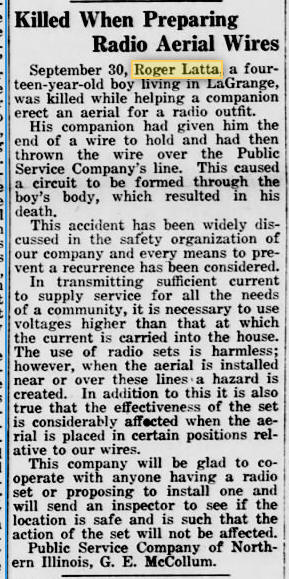
Franklin Park Beacon (Franklin Park, IL) Dec. 1, 1922
Childhood stories Don had told Flossie: "I learned to swim in a stream going through LaGrange. We swam in the nude and loved to put on a show for the nuns who lived near by. On the bank, there was a tree with branches arching over the stream. We would climb the tree, swing on the branches and drop into the water." "My brothers and I spent a lot of time on the farm of our Aunt Meta and Uncle Ed Barnard. My brother Philip and I got into plenty of mischief. One Sunday afternoon after church we went into the apple orchard and picked enough green apples to fill our shirts and knickers. Aunt Meta wasn't mad. She just sat us down with paring knives and a pan and told us to peal every apple."
"Uncle Ed Barnard was a big tease. He had little pigs so he told Phil if he would bite the tail of a little pig that was backed up to the fence, his hair would become curly. Phil leaned down and bit the tail, the pig squealed, ran away and left Phil with a mouth full of hair and dirt." Flossie says, "When "little boys" were fifteen and sixteen years old, they rebuilt an old car. They drove it to Cape Cod and back one summer to visit relatives. They did it with very little money. They didn't notify anyone they were coming. What little money they had was used for gasoline and tire patches. They slept under the car on the hard ground. They only bought enough to keep them from starving. They ate bread and more bread. IF they did not stop at the top of a hill, the car had to be pushed until it could roll downward to start it. They arrived at Cape Cod very dirty, hungry, and completely without funds. I presume their Aunt gave them money for the return trip. It was a real adventure.
Don had been a pinsetter for a bowling alley around the age of 16. He sat above the pins and jumped down to clear pins or reset a new rack on the dots on the alley. He would then send the ball rolling back to the front.
Don told Flossie, "While the Lyons [Illinois] Township High School was being built, on a bet, I walked on my hands around the tower structure, 20 to 30 feet up." Flossie says, "He was a very good athlete, gymnast and daredevil. During college, Don was on the fencing team. He was ambidextrous and won with either hand."
Between 1926 and 1947, the family lived at 222 N. Kensington Ave., LaGrange, Illinois. On May 4, 1928, Don graduated from Lyons Township High School and went on to the University of Illinois for his Bachelors Degree. In 1934, he entered law school.
A newspaper article printed in 1935, wrote "Urbana-Champaign, Ill. John D. Latta 132 South Waiola, was one of 52 students to make an aver of 4 or better for his first semester's work in the U. of Illinois College of Law, it was announced here today by Dean A. J. Harno. The 4. grade is equivalent to 'B' in the letter grading system. The highest obtainable grade is 5. His average for the semester was 4.23. In notifying parents of students with superior scholarship, Dean Harno wrote" 'A real measure of satisfaction comes to me and other members of the Law Faculty in observing the progress of our better students. It is a pleasure to me to tell you that your son has made an excellent record in his law studies during the past semester. Our professional course in law is difficult and I can assure you this represents a fine achievement.'" Flossie says, "Don would have liked to be a carpenter or cabinetmaker or electrician but was told he would not make anything of himself and that challenged him to become a lawyer. His parents could only pay for one child to go to college and that went to his brother. Don had to work to pay for his college and law degree. He belonged to a fraternity at the University of Illinois, but waited tables to earn his room and board. He took a lot of abuse from his fraternity brothers for that.
"Don and I met while we both were working in the Political Science Department. I was in charge of getting the money for those who did extra work. When I asked Don about the extra two hours he had listed, I told him that I'd put it through and if it was OK'd he would owe me a coke. It went through and he bought me a coke. It only cost five cents. From that time on, were were a couple. Neither of us had any money so we spent evenings in the library. Don briefed cases and I kept him company, as I never had homework.
"On Mom and Dad's [Arthur & Maude Witt] 25th wedding anniversary, January 27, 1936, they had an open house I took Don down with me so he could meet my parents and they him. They were not impressed although Don liked them. Later Dad said that to be a lawyer in Chicago one had to be able to lie and cheat. As time went by, they learned to love him."
Don had told Flossie, "My Dad was always trying to find something Phil and I could sell and become rich. He ordered maple syrup from Maine." Flossie says, "They still had some of the syrup when I joined the family." Don had also told her about selling aluminum pots and pans. Don said, "Phil and I had been assigned a territory to sell the pans in. We could only sell at parties We had to fix a dinner to show the people that aluminum was not poisonous. We would buy a nice big pot roast, put it in the sieve pan in the bucket. In the bottom we put a lot of rice and vegetables to the roast dripped juices on them. For a free meal people brought their whole family and soon the food was gone and we did not get a bite to eat." Flossie states, "They never sold much, if any, so I inherited most of the pans. I don't think Phil or Don had the knack for selling."
In a letter written October 4, 1935, to the "University of Illinois, Attention - Mr. H. B. Ingalls, Bursar, Dear Mr. Ingalls: In response to your inquiry of October 1at in regard to Mr. John Donald Latta, I am very glad to testify as to the character and standing of Mr. Latta. I have known him for quite a few years and he is a young man of high character and integrity. I admire his courage and ambition to continue his law course, as I have understood his parents have not been able to assist him as much as they would like by reason of the fact that they were trying to educate several other sons. Mr. Latta is very ambitious to make a success in his chosen profession and I would be very glad to see a loan made to him for that purpose. I believe he is absolutely honest and reliable and I believe he will repay this loan as soon as he is able to earn funds. He is a hard and conscientious student and is somewhat handicapped by reason of the fact that he is working his way through school. I believe he has the ability to make a success if he is able to complete his education and I also believe that he is worthy of any advancement for funds which may be made to him. He has no bad habits, has high ideals and is the type of young may who ought to be given an opportunity. Yours truly, LH."
Don went to the University of Illinois receiving his Bachelor's degree in Liberal Arts and Sciences. After graduation, he entered law school until he ran out of money and left the University at mid-semester of 1935. He finished his law degree at Loyola in Chicago. Flossie says, "I graduated from the University of Illinois in June 1937 receiving my bachelor's degree in Floriculture. Don was still attending Loyola. When Don wanted to marry me, he told his parents of the pending wedding, His parents told him they only had money for one wedding and that went to his brother. [The marriage] was held at Kenwood New Church, Chicago, Illinois. At 2:00 p.m. Rev Percy Billings performed the ceremony. The Best Man was Dr. Philip Latta, and Erma Witt was the Maid on Honor. The guests that were family were Arthur and Maude Witt, Harold and Edna Witt, Lois Witt, Raymond Witt, Ed and Meta Barnard, [Samuel] Wellman Latta and Mary Latta, Philip and Ada Latta, William Latta, Mary E. Latta and Ritz and Myrtle Mulder. [The reception] was held at our apartment at 13526 E. 47th Place in Chicago. Don's brother, Phillip and his wife, Ada presided as host and hostess at the reception. It was a cold October day. The photographer failed to show [up]. We went to the Palmer House on Sate Street in Chicago for our one night honeymoon. That evening we saw the play, 'Brother Rat', at the Selwyn Theater. It was a comedy, which takes place at a Virginia Military Institute in Lexington, Virginia. William (Bill) Latta stayed at our apartment while we were on our honeymoon."
On October 16, 1937, John Donald Latta and Flossie Witt were married in Kenwood New Church, in Chicago, a Swedenborgian church. The newspaper's wedding announcement stated" "Relatives and a few close friends were guests at the wedding of Flossie Witt of Brocton, Ill., and Donald Latta, son of Mr. and Mrs. S. W. Latta of Chicago, until recently at LaGrange, Saturday afternoon at 2 o'clock (October 16, 1937). The ceremony was performed by the Rev. Percy Billings at the Kenwood New Church, corner of Forty-Sixth and Woodlawn Avenue. Miss Agnes Harlan of LaGrange played the wedding marches and the vocal soloist was Mrs. Harold Witt, who sang 'Through the Year' and 'Because'. the bride had her sister, Irma Witt, as her only attendant. Dr. Philip Latta, a bridegroom within the past year, served his brother as best man. The ushers were Harold Witt and William Latta. Burgundy velvet was worn by the bride. She carried a bouquet of small white chrysanthemums. Her sister was gowned in sapphire blue satin and her flowers were bronze pompons. The church was decorated with bouquets of white chrysanthemums and palms. Following the ceremony the reception was held at the apartment of the bride and bridegroom at 1352 East Forth-Seventh place, where Mrs. Philip Latta, the former Ada Weissbrenner of LaGrange, presided as hostess. The couple met while attending the University of Illinois. Mrs. Latta was graduated from the University and has had an interesting secretarial position at the office of the publishers of Time. Mr. Latta works at the Western Electric and in the even attends law [Loyola] school. The bridal couple has been entertained by LaGrange friends on several occasions." The wedding photographer never showed up.
Flossie says, "When Don graduated from Loyola, June of 1938, I was 7 months pregnant and couldn't go to his graduation. I felt very bad to miss it. We were staying with Don's mother and father. We didn't have any money. I got pregnant right away after we got married Don had lost his job with Western Electric and tried selling pots and pans and kitchen itesms agin, door to door like he and Philip did at 15 and 16 years old. He sold only 2 dishtowels. We stayed with Don's parents until Gwen was 3 months old."
In June 1938, John Donald Latta received his Degree of Juris Doctor from Loyola Law School. On August 4, 1938, at Henrotin Hospital, 939 N. LaSalle, Chicago, Illinois, Flossie gave birth to the first of their five children. A girl they named Gwendolyn Alice. Don and Flossie lived at 6121 N. Washtenaw in Chicago.
On December 15, 1938, Don received his "Certificate of Admission to the Bar of Illinois." "In 1938", Flossie says, "the Country was still in the depression and Don was unable to find a job. He had stayed in the Army Reserves as a 2nd Lt [received July 18, 1935, after ROTC in college] and he heard that Junior Officers were needed in the CCC's. He was accepted and sent to Tomahawk, Wisconsin and paid the huge salary of $275 a month." The Civilian Conservation Core, CCC, was one of the programs that Franklin D. Roosevelt (FDR) created to put people back to work during the depression. Many of our state parks, bridges and other structures have signs on them saying they were built by the Civilian Conservation Core. Flossing sates, "Don became a 1st lieutenant on August 29, 1938 at the CCC camp in Tomahawk, Wisconsin. Don had been there several months and I decided to go and join him. Gwen was 3 months old and everybody was sure I was going to give her pneumonia or something. No one knew where Don went and I did not hear from him until he was in Danville, Illinois. So, I took the girls back to Mother and Father Latta's on the train. As we were leaving the train bathroom, the train lurched and door swung back and hit Gwen right in the face. She had a bright red mark from forehead to chin. She made sure everyone knew she was hurt. We moved to Danville from Chicago. We took a bus to Chrisman, Illinois, and from there to Danville. Raymond Witt, my brother, lived with us in Danville."
In 1940, Don was transferred as Administrative Personnel Officer to the CCC camp at Collinsville, Illinois. Flossie says, "While Don was working at Collinsville, we lived in Edwardsville. I was pregnant when we moved to Edwardsville. Before the baby came, Mother Latta came to stay with Gwen. My doctor got sick and his office called and said they would have to give me a new doctor When we called him to say I wasn't feeling well, he said he wanted to examine me. He examined me at 10:00 and Margaret was born at 10:07, I think. The doctor just got downstairs to the waiting room and Don heard me yell. Don said, "That's Flossie." The doctor told Don the birth would be about 4:00 and told the nurse to go and get some pills for me. While she was gone, I stared yelling because Margaret was coming fast. The nurse laid across me and got me into the delivery room. hen I came to, I said, I had a nightmare. The doctor was leaning over me, his tie down to my tummy. He said, 'You had a nightmare; what do you think you did to me.' Margaret's birth certificate originally had unsterile birth on it. It isn't there any more. The doctor wasn't sterilized and I wasn't either."
On August 12, 1940, at St. Joseph's Hospital, on 5th and Oak, in Alton, Illinois, the second daughter was born to Don and Flossie and named Margaret Joyce. St. Joseph's was a Catholic Hospital and religious medals were kept pinned on her while in the hospital. We lived at 721 Randle St., Edwardsville, Illinois. Flossie says, "The mayor of Edwardsville furnished free transportation for us to get to the hospital in Alton. I don't know how Don got home. When he came to visit, he used a military car. Flossie was told by the doctor, "Margaret was a menstruating baby. Her little body was trying out all its new parts." Flossie says, "This vaginal bleeding continued for four to five days." When I told grandmother Eliza Witt about it, she declared that Margaret would never have any children, but she had three.
In Edwardsville, when Gwen was still 2 years old, she followed the grounds keeper of the apartment building around whenever she could. Gwen says, "He was a good surrogate dad." Flossie continues, "They were sitting on the steps of the building when he gave her a sucker. She immediately began to enjoy it. When she had been sucking it for a spell, she took it out of her mouth, looked at it and said, 'This god damned thing is almost gone.'" Gwen said, "I'm sure it was a direct grounds keepers quote."
Flossie says, "Don got transferred to Pekin, Illinois. I was in the hospital 5 days with Margaret. When I got out, Dad [Arthur Witt] and a neighbor came up and moved me out. I moved back to Mom and Dad's with what little furniture I had with me, which wasn't much. We joined Don in Pekin. Our address as 1318 Henrietta St., in December 1940." Flossie says," Don got his notice to report to Ft. Knox, Kentucky by February 11, 1941 to military service for one year. Don went to Ft. Knox and we joined him there. I was never left behind. I always caught up." Flossie said, "The girls and I moved to Indiana, just north of Ft. Knox and from there we moved to Vine Grove, Kentucky, into a duplex. There was an old barn on the property. Gwen loved to play in it. She would come home with all these 'trophies' that kids find."
The Japanese bombed Pearl Harbor on December 7, 1941. In August 1942, Don was transferred to Camp Beale in Marysville, California. Flossie says, "The girls and I went with him to Marysville/Yuba City and moved into a new house, a little tiny place with 2 bedrooms.
Flossie typed these pages a long time ago. "When I began thinking about Christmases that I've celebrated immediately 1943 came to mind as one of my most eventful. In Sept of 1942, Don was transferred from Ft. Know, KY, to Camp Beale in Calif. We had two little girls, Gwendolyn and Margaret. The first part of the year was rather uneventful. Don was Captain in the 13th Armored Division and he was very busy training a contingent, sending them overseas and then getting another division to train. The girls and I were busy. We had wonderful neighbors and the girls had plenty of playmates. Next door was a young couple, he worked for a power company. He knew Gwen loved pomegranates so he brought in some occasionally, which he picked off wild trees growing along the road. "There were many Chinese gardeners and about two blocks from our house was a wonderful vegetable garden owned by a Chinaman. I often sent Gwen to get green beans, which were called yard longs. She would come back with a handful of beans. Gwen was five in August so was old enough to go to the gardens. She loved it. Later we heard that his Chinaman was a child molester.
In April, I became pregnant with our third child which was to complete our well planned family. The due date of our new arrival was Dec. 12. Gwen was excited as she was to start kindergarten in Sept. The first part of Aug. the girls were invited to a birthday party for a friend whose mother and father operated the Salvation Army store. They had a housekeeper. About a week after the party and on the same day, the girls developed sore throats and a high temperature. The Doctor suspected scarlet fever but he wasn't certain as we hadn't been out of town and there wasn't any in the county." In a couple of days both girls began to show the scarlet coloring and a faint rash. Immediately that dreaded sign went up on our door. "Keep Out - Quarantined."
42 FRANKLIN W. (6) LATTA
Samuel Granger (5) Samuel R. (4) John (3)
John (2) E____ (1). Born Aug. 4, 1897; d. Feb. 28, 1958; m. Ruth Fumbranks. She
was born Dec. 4, 1899 and died Dec. 25, 1992. They are buried at the Fairview
Cemetery, Dyersburg, Tenn.
Children:
53 SAMUEL GRANGER (7) b. Sept. 4 1921; d. Dec. 21, 1980; married Margaret Thompson on Sept. 17, 1948; buried in Piedmont, AL.
54 RUTH FUMBANKS (7) b. Jan. 10, 1923; d. Feb. 10, 2001; married Richard Leow on Nov. 2, 1943; buried in Fairview Cemetery, Dyersburg, TN.
55 BETTY NEELY (7) b. Oct. 17, 1925 (twin with Jane); d. Nov. 3, 2012; married Charles Ratcliffe on July 11, 1947; buried in Natchez, MS.
56 JANE EYRE (7) b. Oct.
17, 1925 (twin with Betty); d. August 17, 2019; m. Robert Franklin Little.
Jane grew up in Dyersburg and attended the University of Mississippi. She
met her husband during World War II at the Dyersburg Army Base, and they married
on March 3, 1945. She was a member of the Dyersburg Cumberland
Presbyterian Church, and served nine years on the Board of Trustees of the CP
Children's Home in Denton, TX. She was a member of the Good Earth Garden
Club, which she enjoyed for many years. Known for her love of porcelain
china painting, she was most proud when her pieces won blue ribbons at the Dyer
County Fair. She was a member of the West Tennessee Porcelain Guild.
Jane and her husband had no children of their own.
______________________________________________________________________________
THIS IS THE END OF THE BRANCH.................NOTES BELOW
______________________________________________________________________________
The following autobiographical account was submitted by Dorothy B. Ruhmann,
great-granddaughter of Samuel Rankin Latta. It was originally written in 1886.
Samuel R. Latta was born on the 2nd day of December 1827 in the village of New
Alexandria, Westmoreland County, Pennsylvania. His father, John Latta, was born
in Lancaster County, Pa., on the 15th day of April 1796, and was of Irish
parentage--his father and the grandfather of the subject of this sketch,- John
Latta Sr., having migrated to this country from Ireland late in the eighteenth
century. John Latta Sr., moved at an early day to Westmoreland County, in
western Pennsylvania. He was a mill-wright, and was killed in the erection of a
mill on Loyalhanna Creek, early in the century. John Latta Jr., learned the
saddler's trade in Greensburg, the County seat of Westmoreland County, and while
carrying on his trade in New Alexandria, in the same county, he intermarried
with Lucinda Ellen Gilchrist, on the 22nd day of April 1823 Lucinda, his
wife was born in Dauphin County, Pa., on the 31st day of March 1793. Her parents
were John Gilchrist, who served as a lieutenant in the Revolutionary War ---,
and Ellen Berryhill, both of whom were of Irish descent. John Latta Jr.'s mother
was named Mary Rankin and she died at the home of her son in New Alexandria, on
the 20th., of January 1826, age 73 years. He had but one sister and no brothers
and the sister died while quite young. To John Latta Jr. and his wife, Lucinda,
were born, in the village of New Alexandria, Westmoreland County, Pa., children
as follows, to wit:-
John Gilchrist Latta, born May 1st. 1824
William
Berryhill Latta, born February 1st. 1826
Samuel Rankin Latta, born December
2nd. 1827
James Mitchell Latta, born October 16th. 1829
Francis Henry
Latta, born October 28th. 1831 and
Francis Henry Latta, 2nd., born December
5th. 1835
Both the latter died in infancy, the first December 11th. 1832 and
the second on the 24th. of February 1837. The former lies buried in the
graveyard of Congruity Church, five miles west of the village, and the latter in
the graveyard of the Presbyterian Church in New Alexandria. After carrying on
his business in New Alexandria until the Spring of 1837, making but a very
scanty living, though practicing the most rigid economy, John Latta and his
wife, with their remaining children, removed to Blairsville, a town some ten
miles away, in Indiana County. It was situated on Conemaugh River, along which
was the Western division of the Pennsylvanian canal. Here they continued to
reside, John Latta carrying on his trade. By practicing the most rigid economy,
they bought and paid for a comfortable home, where they raised their children
respectably. They were strict Presbyterians, of the strictest of their sort of
that day. The children were all required to attend Sabbath-school, church and
prayer-meeting, as a matter of course, and there was no excuse sufficient except
sickness. On the Sabbath there was no sort of recreation allowed. The children
were not permitted to go on the streets except on the way to church or to
Sabbath School, and the writer remembers that a funeral happening on Sunday was
a sort of God-send to the children of the family, because they were to attend
funerals on Sundays, and thus might get out from home. No books or newspapers
were allowed to be read on that day, except the most religious ones; and it was
regarded as an awful sin to whistle, even a hymn-tune on that day. It was
obligatory on all Presbyterian children to commit to memory the Shorter
catechism, and on every Sunday evening, the children were called together, and
made to recite it to the father. In those days, the catechism was one of the
tasks required of Presbyterian children at the secular schools, and the writer
well remembers reciting his daily task of catechism, to the then teacher of the
secular school in New Alexandria, John W. Geary, who was afterwards a Colonel in
the Mexican War, a Major General of volunteers in the war between the North and
South, and then Governor of Pennsylvania. At the time Geary was teaching in New
Alexandria he could not have been more than twenty years of age. The rigid
economy practiced in the days when John Latta and his wife were thus bringing up
their family of boys, is but little known or practiced by their descendants in
the good year 1886, in which this is written. I have no idea that the whole
yearly expense of my father's family in those days, was over $400.00 and yet,
children were as well cared for then as now, though their clothes and schooling
did not cost as much; but that was because they were not given as much, and
taught to make them last longer. Provisions and clothing at the present day, are
as cheap as they were in the years from 1840 to 1850, and perhaps more so. Of
the four surviving sons, the eldest John G., and the youngest, James M. both had
good English educations, and both learned their father's trade, working with
their father until after they were grown. The third son, Samuel, was also put
into the shop to learn the same trade, but about the year 1842, a classical
school was opened in Blairsville, and an old gentleman, Capt. Wm. Smith,
persuaded Samuel that he ought to persuade his father to let him go to the
Academy. When the notion once got into the boys head, he gave his father no
peace. The father reasoned with him; that he was wholly unable, on account of
his limited means, to give him a classical education. The boy's reply to this
was, that he only wanted his father to pay his way until he was qualified to
teach, and then he would work his own way. The father then wanted to know what
the boy wanted to make of himself. The boy's reply was that he wanted to be a
missionary. The boy may
have thought so then, but has suspected since that
there was some slyness in it.
However, he gained his point, and for three
years he went regularly to the Blairsville Academy, then under the charge of Mr.
Matthew McCall. At the end of the summer of 1845, the father told the boy, that
he had done for him all that he could, and that the time had come when he must
bear the expense of his own schooling. In those days in Pennsylvania, the
Free-schools were kept open in the county about five months
each winter, and
in the fall of each year the school directors of each township would advertise
that a given day at a certain place in the Township they would meet to examine
such parties as wished employment in the township as teachers through the
winter. So in August of the year 1845, Samuel presented himself, before he was
eighteen to undergo the dreaded examination. Among a crowd of a dozen or more,
who were there for the same purpose, he was by far the youngest. The examiner
was the Rev. Dr. McFerin, a venerable Presbyterian divine, who was pastor of the
Congruity Church in the neighborhood for fifty years. The examination passed off
successfully
and Samuel was employed to teach that winter in District
No.----(Shields' schoolhouse) for a five months term at $17.00, out of which
wages he paid board at $1.00 per week. But at the end of the term he had $50.00
in clean cash It was now the Spring of 1846. Samuel was flush with money all his
own, and it struck him that it would be better to try to increase it by trading
than to spend it just then in going to school. So, in answer to an advertisement
in a Philadelphia newspaper, he undertook to canvass a district composed of
Franklin County, East of the Mountains, for a book-publisher, by whom he was
guaranteed to clear at least $25.00 per month in selling the publisher's
attractive books. So Samuel invested $25.00 of his winter's wage in books,
which he found when they arrive in Blairsville, were nothing more than very
cheap illustrated novels. But he was in for it. His money was in those
books and it had to be gotten back somehow. The first question to be decided
was, how was he to get to his territory east of the mountains? There were no
railroads in those days. So he bargained with the owner and conductor of a
canal boat, a section boat, for a cheap fare on his boat to Harrisburg,--
cheap in consideration of Samuel's rendering what aid he could in running the
boat. So on this section-boat he shipped himself and his box of books, bound to
Harrisburg by the canal, from whence he was to go to Chambersburg, the county
seat of Franklin county and the center of his territory. The memory of
that trip over the mountains on that section-boat is a pleasant one. The boat
was loaded with shelled oats in bulk, bound for Philadelphia, and the oats
was his bed for ten nights it took to reach Harrisburg. How did the boat
cross the mountains? Between the Western and Eastern divisions of the canal,
on either side of the mountains, was a railroad. The mountains were
crossed by a system of inclined planes. The boat was built in sections. Upon its
arrival at Johnstown, at the Western foot of the mountains, railroad trucks
were run down into the water, the boat's sections were taken apart, and each
section was loaded upon a truck. Then a locomotive, or sometimes horses
driven tandem, hauled the train on a level several miles, until they reached
one of the inclined planes. These inclines were from a mile to a half mile in
length, and rose up the mountain at an angle of perhaps 30 or 40 degrees. The
train was drawn up these inclines by stationary engines at the top, the train
being attached to an endless wire rope. By this system of levels and
inclines, the boats were taken over the mountain and deposited again in the
canal at Hollidaysburgh on the Eastern side of the mountain Down the
beautiful Juniata amid the mountains, down the lovely Susquehanna with its ever
changing scenery, at the rate of about four miles an hour, passed the young
traveler, enjoying at night his bed on the shelled oats, as well as if it
had been a bed [of] down Two things at Harrisburg made a lasting impression
upon his memory. One that war had actually begun between the United States
and Mexico; the other was seeing the first Telegraph wire he had ever seen,
and which was then a new thing in the world. On Saturday evening he arrived
at Chambersburg, the centre of his work, and on Monday morning he entered on
his new occupation. As before said, the books were cheap novels, costing six
and thirteen cents each. The former were sold at twelve and a half and the later
at twenty-five cents each. The traveling had to be done on foot from house to
house and from town to town. The books in a carpet sack made a heavy load,
for enough had to be thus carried to make a weeks sales. At the end of the
first week, the young merchant returned to Chambersburg, footsore and
wearied. A net calculation showed , that by very hard work, sometimes walking
twenty miles a day, he had made clear of expenses, about seventy-five cents
per day. Living cost but little, as he stayed in country houses, where, if
they made a charge at all, it was very small. Again on Monday he started
on his weary tramp. The books must be sold, but another week and weary
trapping
over
hot and dusty roads with but poor success in the way of sales, brought
great disgust. One weary day he traveled long into the night, before he
found a house that would take him in, and he began to think of trying
something else. He could do nothing but teach and inquiry disclosed the fact
that in the village of Loudon, situated just at the foot of the Blue-Ridge, they
wanted a teacher and thither he wandered his way. His youth was against him
he was only eighteen. But fortune favored and he got a situation for a term
of five months at $18.00 a month. He put the balance of his books for sale on
commission in a bookstore in the town of Mercersburg, taught the five months
out, and then in the fall, staged it home over the mountains. The following
winter, he taught a country free-school, at McClellands school-house, in the
Conemaugh Township, Westmoreland County, Pa., at $19.00 per month. The following
summer
he attended the Blairsville Academy for five months and the following
winter taught another five months session at McClellands. The following
summer he taught a five month's session in the public school at Blairsville,
as assistant teacher, at $20.00 per month, and the next winter at Youngstown,
a village in Westmoreland County at $25.00 per month. Having now made enough
money to try college, in the spring of 1848, he entered Washington College at
Washington, Penn., entering the Junior class half-advanced. At the end
of the first five month's session, the whole of the junior class rebelled
against the faculty, on account of their suspension of one of their number,
and refusing to attend recitations, the whole class was suspended. Part of
the class bought their peace by yielding to the demands of the faculty.
These were such students as were subject to and dependent upon parental
authority. About half of the class, among them the writer, refused to submit
and left school, and were suspended. In a short time they were all admitted
into Jefferson College at Cannonsburg, Pa., and graduated in the summer of
1850. In the fall of that year, he found employment as a chain carrier with a
party of engineers and engaged in surveying the route of the Pennsylvania
Central Railroad, on the eastern slope of the Allegheny mountains, from
Altoona to the top of the mountains.
The new flourishing town of Altoona, at
that time, consisted of one whiskey shop. While thus engaged with the
surveyors, the writer earned $1.00 per day and accumulated about $40.00., and
then determined to go south, where the wages of teaching were better. So about
the middle of October he left home, traveling down the Ohio from Pittsburg by
steamboat. He took passage to Memphis, expecting to teach in West Tennessee
or North Mississippi but on his way down the Ohio, hearing of several
situations in West Tennessee, where he might find employment, he stopped at
Hickman, Kentucky, and carrying a carpet bag weighing at least forty pounds, he
walked from there to Dyersburg, a distance of fifty miles. He obtained
employment as a teacher in the public academy and continued to teach for three
years. His wages as a teacher during those years varied somewhat, averaging
perhaps about $60.00 per month. In 1852, he purchased the piece of land about
half a mile north of the town of Dyersburg, where he now lives, (1886), built a
little house upon it, and in December of that year, he married Miss Mary Granger
Guthrie, at Eaton in Gibson County, Tennessee, and brought his young wife to
that little house. The house has grown as their family increased, but they have
never changed their residence, nor do they expect to do so, until they are
called home. While teaching, he had been studying Law, and in the summer of 1854
he was admitted to the bar at Dyersburg, and at once entered on the practice of
his profession in partnership with his preceptor, T. E. Richardson, Esq. He
continued the practice of his profession actively and successfully until the
breaking out of the Civil War. His sympathies were warmly with the south, and in
May 1861, he assisted in raising a company of twelve months volunteers, of which
he was elected captain, and joined the Tennessee troops, then under the command
of General Gedion J. Pillow at Randolph on the Mississippi River, where he and
his company were mustered into service. At the Battle of Belmont, in
Missouri, his company which was in the 13th. Tennessee regiment, was engaged and
lost three killed and twelve wounded, among the latter, himself slightly. Again
at the Battle of Shiloh or Pittsburg Landing, his company were engaged, and
suffered severely in killed and wounded. After this battle, his time having
expired, he was discharged and his health and the situation of his family
forbade his again entering the service, and he remained at home during the
remainder of the war, though his sympathies were as much as ever with the South.
After the war he resumed the practice of his profession actively and profitably,
but in the flush times succeeding the war he indulged in buying real estate, and
in the crash of 1873 and succeeding years, he suffered severely, though never to
insolvency. Mary Granger Guthrie, his wife, was born on the 8th. day of
August 1833, at Bright Hope Furnace in Green County, East Tennessee. Her
father was John Guthrie, one of the proprietors of that furnace. He was a
Scotchman by birth and education, but the time and place of his birth are
unknown to her. Her mother's name was Minerva Wear, a daughter of Samuel Wear.
John Guthrie, before engaging in the iron business, had owned or managed a paper
mill in Knoxville, Tennessee. About the year 1840, he disposed of his iron
interest and moved with his young family to Missouri, and settled with his
slaves in Polk county, but stayed there but a short time, perhaps a year, and
moved back, and settled at Columbia, in Maury county, in Middle Tennessee, where
he bought a mill on Duck River, but before he had time to make it a success, he
lost his wife, and in a few months he followed her, dying in 1844. He and his
only son, an oldest child, Franklin Wear Guthrie, both died the same day, the
latter than being about fourteen years of age. He left surviving him five
daughters named as follows: First Catherine Margaret, who intermarried with Dr.
Thomas W. Kelton, of Gibson County, Tennessee, in the year 1847. Second, Mary
Granger; Third Helen Marr, who intermarried with Dr. John Hocker in Mt. Vernon,
Lawrence County, Mo. They both died soon after their marriage without issue.
Fourth, Victoria, a bright and intelligent girl who at the age of nineteen, in
the year 1863 became insane, and is yet living, an inmate of the asylum at
Fulton, Mo. Fifth, Martha who died when about twelve years of age, in Arkansas,
where she was living with Dr. Kelton. Mrs. Kelton is still living in Mt. Vernon,
Mo. She has living the following children: Thomas, living unmarried at Mt.
Vernon, Mo. Dora, intermarried with Manse Gaither, and now also living in Mt.
Vernon, Mo. Lucy, intermarried with Frank Smeltzer, and now living in Van
Buren, Ark. Richard unmarried,and now at Mt. Vernon, Mo. Martha intermarried
with George A. McCanse, and also living at Mt. Vernon, Harry, Granger and
Thaddeus, lads all living with their mother. Mary Granger,- wife of S. R. Latta
(and so named after the wife of Gov. Willie Blount, of Tennessee) was educated
at the Columbia Female Institute, graduating there from in the year 1849. After
Dr. Kelton intermarried with the oldest daughter, Catherine, he was appointed
guardian of all the younger children, and removed them all from Columbia, to his
home in Gibson County, Tenn., and it was there that she was married as stated
above. To Samuel R. Latta and his wife, Mary Granger Guthrie, there have been
born children as follow:
First: John Guthrie Latta, born at Dyersburg, Tenn.
June 21st 1857
Second: Kate Latta, born Oct. 17th, 1859
Third: Sarah Knott
Latta, born February 12th, 1862
Fourth: Mary Elenora Latta, born March 9th,
1864
Fifth: Franklin Wallace Latta, born July 4th, 1866
Sixth: Samuel
Granger Latta, born August 5th, 1871
John Guthrie Latta, the oldest son, was
married to Miss Lee Poland in Marshall, Texas, on the sixth day of December,
1882, and to them have been born two children, -Leslie, a daughter, born at
Marshall, Texas, Nov. 1883, and Nell, a daughter, born at Dyersburg, Tenn.,
April 24, 1886. Kate the second child of Samuel R. and Mary G. Latta,
intermarried with Thomas C. Gordon, at Dyersburg, Tenn., on the 25th. of June
1879 and to them have been born thus far (1886) three children, thus: Mary, born
April 26th. 1880 Winfield Osceola, born January the 21st. 1882 Sadie Louise,
born July 27th 1884.
Returning to the Latta family: John G. the eldest son, as
before stated, learned his trade with his father in Blairsville, Pa. but in the
year 1852, his health having somewhat failed, he came to Tennessee, and taught
school in Dyer county for over a year. In the summer of 1854, Samuel R. and
his wife and John G. Latta visited their parents in Pennsylvania, and the
next year the old people, with their son William B. and their son James M. and
his wife and child all removed to Dyersburg, Tenn., and James G and James M.
Entered into partnership, in carrying on their business of saddlery.
A short
time after his parents came to Tennessee, Samuel R. enlarged his house and took
his father, mother and brother Wm. B into his family, and with him they lived
until their deaths many years afterwards.
John Latta, the father died
December 1872
Lucinda E. the mother died October 28th. 1874
William B.
died January 23rd. 1877
Of the latter, it can only be said, that he was of
weak mind. He remained, mentally always a child, and was never capable of taking
care of himself. He lived with his parents, and with his brother Samuel, up to
the time of his death John G. Latta, the oldest of the brothers, married in the
year 1861 or 1862, Miss Mary Silsby.
She was a New England woman and was
visiting her brother Mr. Howard Silsby, when he made her acquaintance. In 1862,
he took his wife and first born child to Newton, Mass., the residence of her
parents, and shortly afterwards was appointed post master of that city, and has
so remained until now, 1886. By his wife, Mary Silsby, there was born to him the
following children: First: Lilian, born in the year 1861; Second: Florence, born
about the year 1863; Third: Mary, born about the year 1865; Fourth: Jennie, born
about the year 1867. The latter died quite young. The others are all alive. His
wife, Mary Silsby, died about the year 1869, and a year or so afterwards, he
married Miss Nellie----, by whom he had two sons, one of whom died in infancy
and the other named Samuel, still survives.
James Mitchell Latta, while
carrying on his business successfully died at Dyersburg on the 27th of September
1857, and was buried at Hurricane Hill Church, about five miles north of
Dyersburg, Tenn. He left two children and his widow surviving him.
Lucy, the
oldest of his children, was born at Blairsville, PA., about the year 1853, and
intermarried with John G. Seat, at Dyersburg, Tenn. about the year 1874 or 5.
They still reside in Dyersburg and have three children: Glenn, a boy about
thirteen, Birdie, a girl aged about eleven and a third child (daughter) born to
them a few days ago.
Samuel R. Latta, and his wife, Mary have now (December
1886) been married, nearly thirty four years. They were married December 1852.
They are yet occupying the same house in which in their young days, they began
housekeeping, though it has been enlarged as their family increased. It is
situated about half a mile north of the village of Dyersburg, and the same
forest trees are still around it, amid which it was originally built. Although
West Tennessee has always been regarded as an unhealthy country the family has
always had good health. Death, has never entered their home. They have always
had enough to eat and wear and in all things have always had enough to eat and
wear and in all things have always had abundant cause for thankfulness to a kind
Creator for unnumbered blessings.
(After the mention of Lucy, as the daughter
of James M. Latta, above, should have been
mentioned his son, Samuel James
Latta, born in Dyersburg, Tenn., in the year 1857. In the year 1885 he married
Miss Betty Cowan of Memphis, Tenn., and is now residing in that city.
I have
written the above brief history, that my children and their descendants may know
more of their mother and father, and their kinsmen, than I know of mine.
The
question might well be asked--"cui bono". Well, it is hard to say. It may
satisfy some curiosity, at least. There is something in each one of us that
prompts the quere, "who was my father? Who was my grand-father or my
grand-mother? And if one can trace back their lineage, through a long line of
ancestors they are disposed to boast themselves upon it. This perhaps is well.
But again the question comes, "cui bono"? Where is now the descendants of Caesar
or Alexander? Or of more recent days, where is now the family of Washington, or
who cares for them? Victoria, queen of England, may be able to trace back her
history through many names, but what is there to boasting it? Not a name in the
whole line as illustrious as that of Washington or Lincoln. And how far back can
the name Lincoln be traced? Or a hundred years from now, who may be able to
trace to him, their parentage?
We have in our family bible printed in the
year 1601, in London. It is in old English type. It is now owned by John G.
Latta, as the oldest son of our father. There is in it some family records, of
which we know nothing. About all that can be learned, is that we have been a
Protestant family for many years, but that is all. Our grand-father came from
Ireland; that we know. But where did they come to Ireland from? It is more of a
Welsh name, than Irish, but if they came from Wales to Ireland, from whence came
they to Wales? Who can tell, and why should anyone care to know?
Still, the
world is prone to pride itself, upon its ancestry, but for what good reason, it
is difficult to tell. This is true, that it is important that each individual
should so well act his or her part on the stage of life, as to leave their
posterity and to the world, an untarnished name. In doing this, they have more
to boast of, than they could possibly have, by ability to boast of a long line
of ancestry, however distinguished that ancestry may have been.
For all that
however, it would be a matter of great pleasure to me, if I could have, even a
brief history of my ancestors, telling me of their lives, and actions; where and
how they lived, who were their ancestors, and where they lived. Such a record
may have once been prepared, just as this is, who can tell? And a hundred years
from now, this may be as unknown as if it had never been written. Who can answer
for it? No one.
Some of my children, or my grand children may some day read
this, and add to it their history for their children. And it may thus go down
from father to son, or in a few brief years there may be no one who will care
for it at all. Well, so be it.
[Later: this was added to the above history
twenty years later in longhand, by the S. R. Latta, writer of the above.]
In
an idle time, July 11, 1906, I have re-read this. It is about twenty years since
I wrote it. We are all living and well. My grand-children number twenty-five in
all all living. Three died in infancy. Our great-grand-child, Gordon Pelham, a
bright boy, son of our oldest daughter's daughter, Mrs. Kate Gordon, has been
born to us. My wife and I are still living in the same old house where we began.
Today, we are expecting our daughter, Sadie K. Anderson, wife of Rev. Dr. W. M.
Anderson, pastor of the first Presbyterian church at Nashville, Tenn. with her
six boys, to spend a month in the old house with us. When she arrives, my whole
family will be here -- not one missing -- except Dr. Anderson, numbering in all,
-- parents, children, and grand-children, and great-grand-children, forty souls
- less one, Dr. Anderson being the only missing one.
A very special thank you to Sarah
Hutcherson, who transcribed The State Gazette newspaper articles and for
consenting to our using them on this web site.